
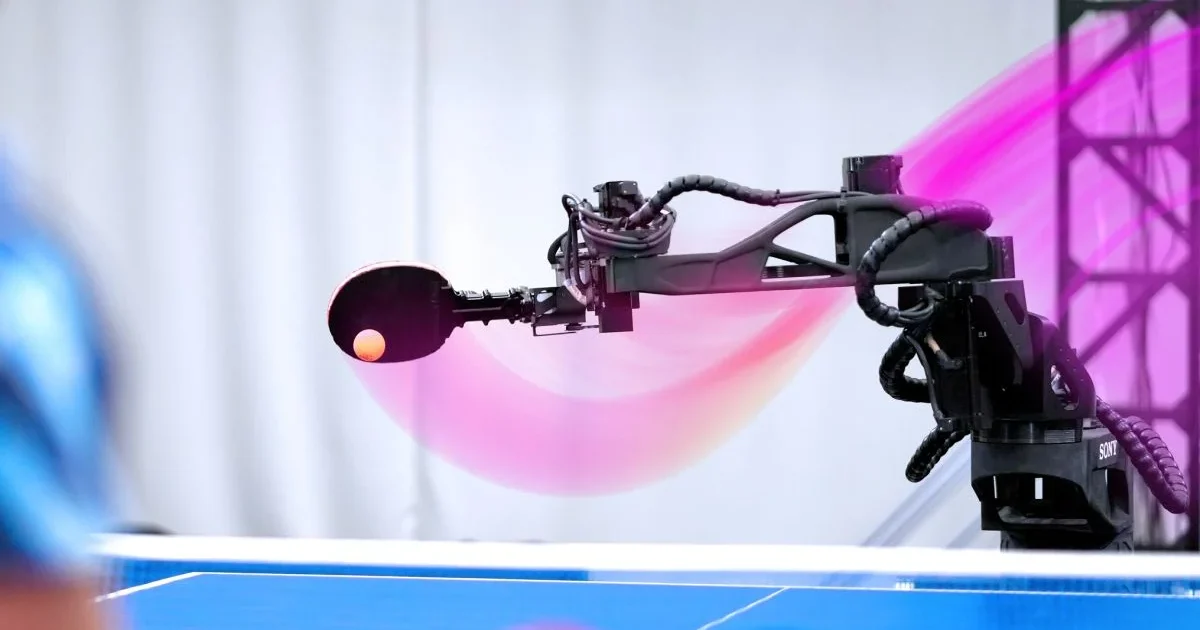

Sony AI robot Ace defeats elite table tennis players while humanoid robots win Beijing race. See how physical AI is changing sport.
Sony AI Robot technology reached a dramatic milestone after autonomous table tennis machine Ace defeated elite human players in official matches, while humanoid robots also impressed at the 2026 Beijing race.
The breakthrough confirms that artificial intelligence is no longer limited to chess boards or computer screens. It now performs in fast, unpredictable physical environments where speed, reflexes, and precision matter most.
Sony AI developed Ace to compete under official International Table Tennis Federation rules, with licensed umpires overseeing matches. In tests first documented in April 2025, Ace won three of five matches against elite players. Later sessions in late 2025 and early 2026 reportedly included more victories over professional-level opponents.
Peter Dürr, Sony AI Zurich director and project leader, said the challenge goes beyond traditional software competition.
“Unlike computer games, physical and real-time sports like table tennis remain a major open challenge.”
How Sony AI Robot Ace Defeated Human Players
Ace uses nine synchronized cameras and three vision systems to read ball speed, spin, and trajectory in real time. The robot processes movement so quickly that it can detect actions difficult for the human eye to follow.
Its racket arm contains eight mechanical joints, allowing sharp angle control, power variation, and fast directional changes.
Unlike many AI systems, Ace did not learn by copying humans. Instead, it trained itself through simulation, creating patterns and strategies unfamiliar to players.
Professional athlete Mayuka Taira admitted the machine created a new kind of pressure.
“Because you can’t read its reactions, it’s impossible to sense what kind of shots it dislikes or struggles with.”
That emotional neutrality gave Ace a major competitive edge.
Humanoid Robots Also Shine in Beijing Half Marathon
The rise of physical AI continued in China, where more than 100 humanoid robots entered the 2026 Beijing E-Town Humanoid Robot Half Marathon over 21 kilometers.
Robot Lightning, developed by Honor, finished in 50 minutes 26 seconds despite crashing into a barricade mid-race. Organizers still declared it the official autonomous winner.
The event featured around 12,000 human runners on separate tracks and served as a large-scale test of robotics under real-world pressure.
Why This Matters for Football and Global Sport
For sport industries, robotics may soon influence training analysis, reaction drills, rehabilitation, and smart coaching systems. In football, similar AI could transform goalkeeper simulations, tactical data reading, and performance recovery.
Sony AI Robot Ace proves one clear point: machines are no longer just assistants—they are becoming competitors.